About Entente
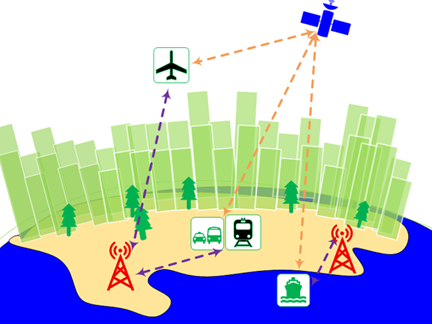
NTNs are essential for delivering broadband services to areas beyond the reach of terrestrial infrastructure and ensuring reliable communications during emergencies. NTNs play a critical role in providing connectivity in regions where terrestrial infrastructure is unavailable, limited, or compromised.
Today, commercial mega-constellations are deployed for mass-market connectivity. Instead, IRIS², standing for Infrastructure for Resilience, Interconnectivity, and Security by Satellite, will deploy approximately 290 satellites in Ku- and Ka- bands. The aim of IRIS² is to target secure governmental links, higher resilience, and avoidance of strategic dependencies on non-EU infrastructure. Based on a multi-orbit LEO and MEO architecture complemented by GEO satellites, IRIS² will, once fully operational, also provide broadband services to private companies in remote environments and European citizens in underserved areas.
By adopting 3GPP Releases that support NTN, IRIS² will benefit from an open and mature standard. This strategy enables seamless TN-NTN integration in a unified infrastructure, while reducing dependence on proprietary technologies. A 3GPP-native IRIS² equips terminals with native multi-connectivity capabilities, promotes interoperability among vendors, and allows Europe to benefit from the global economies of scale.
In this context, ENTENTE’s ambition is to narrow the performance gap with global incumbents in terminal hardware, to redefine the architecture and to establish an industrial landscape in Europe that ensures sovereignty, competitiveness, and sustainability. To achieve this vision, ENTENTE targets the in-orbit validation of an integrated TN-NTN system. The user segment builds on the development of a modular Ka-band flat-pannel antenna, interfaced with a multi-connectivity modem capable of establishing connectivity over TN and NTN links. Multi-connectivity management across TN and NTN domains will be enabled through the implementation of data steering, switching and splitting policies as well as the development of a cloud-native architecture, where functions such as routing, AI-based resource allocation, or data fusion can be dynamically placed on ground or space nodes.
Project Objectives
The main goal of ENTENTE is to design, develop and demonstrate integration of TN and NTN. To realise this ambitious goal, the project will pursue the following specific objectives:
-
· Objective 1: Develop a harmonized TN and NTN architecture enabling multi-connectivity to support mission-critical services and their requirements
-
· Objective 2: Develop a Ka-band flat-panel antenna, RxTx chains and ACU
-
· Objective 3: Develop end-to-end TN–NTN modem platform for seamless multi-connectivity
-
· Objective 4: Develop a multi-connectivity framework considering ATSSS procedures and mobility-aware reliable service operation
-
· Objective 5: Unified hardware platform of a dual-mode TN–NTN modem, ready for integrating with Ka-band flat-panel antenna ACU PCB
-
· Objective 6: Strengthen EU sovereignty by reducing third-country dependencies across device, RF, and core
-
· Objective 7: In-orbit validation (IOV) of the end-to-end TN–NTN system
-
· Objective 8: Dissemination and communication